
Introduction
Did you know Ontario homeowners and real estate investors can reclaim thousands of dollars in tax rebates through the HST Rebate Program? Whether you’ve purchased a newly built home, invested in pre-construction real estate, or completed a major renovation, you may qualify to get a significant portion of your Harmonized Sales Tax (HST) back in 2026. 💸
The Canada Revenue Agency (CRA) continues to offer generous rebates to ease the tax burden for homebuyers, builders, and landlords. However, understanding the eligibility criteria, forms, and timelines can be confusing without expert guidance.
This 2026 HST Rebate Guide by ANKTax Mississauga walks you through everything, from rebate types and forms to real examples and insider tips, so you can confidently claim what you’re entitled to and put money back in your pocket.
What is the HST Rebate in Ontario?
The HST Rebate in Ontario, or Harmonized Sales Tax Rebate, is a refund provided by the government to eligible individuals and businesses for part or all of the HST (a combination of federal GST and provincial PST) they have paid on qualifying purchases or expenses. This rebate is designed to alleviate the financial burden of HST in specific scenarios, such as buying a new home, renovating, or running a business in Ontario.
Key Facts:
- Ontario’s HST is 13% (5% federal + 8% provincial).
- The rebate helps recover a portion of this tax when you buy, build, or substantially renovate a property.
- Both homeowners and investors can qualify — though the rules differ slightly.
- You generally have two years from your closing or completion date to apply.
Example:
If you bought a $500,000 new home in Ontario, you paid $65,000 in HST. You could recover up to $30,300 through federal and provincial rebates, depending on eligibility.
Note: If you’re a small business owner in Ontario and the property you’re claiming an HST rebate on is related to your business operations or rental income, it’s essential to understand how your overall tax filing can affect your eligibility and refund amount. Check out our guide to filing small business taxes in Canada for key insights on deductions, compliance, and HST reporting obligations.
Types of HST Rebates Available in Ontario
There are several types of rebates based on the type of property and its use:
1. New Housing Rebate (Owner-Occupied)
For individuals who purchase or build a new home as their primary residence.
- Applies to detached homes, condos, and townhouses.
- Maximum federal rebate: up to $6,300.
- Maximum Ontario rebate: up to $24,000.
2. Rental Property Rebate (New Residential Rental Property Rebate – NRRPR)
For investors purchasing new homes or condos intended for long-term rental.
- Must have a minimum one-year lease agreement.
- Claimed using Form GST524 + Schedule A.
3. Substantial Renovation Rebate
If you renovate 90% or more of your home’s interior, you may qualify.
- Includes major interior or structural changes.
- Claimed using Form GST191.
4. Pre-Construction Home Rebate
For buyers who purchase directly from a developer.
- Many builders include HST in the sale price and apply for the rebate on your behalf.
- Always verify in your Statement of Adjustments.
5. Modular or Mobile Home Rebate
- Special eligibility for manufactured or modular homes used as a primary residence.
Who Qualifies for HST Rebates in Ontario?
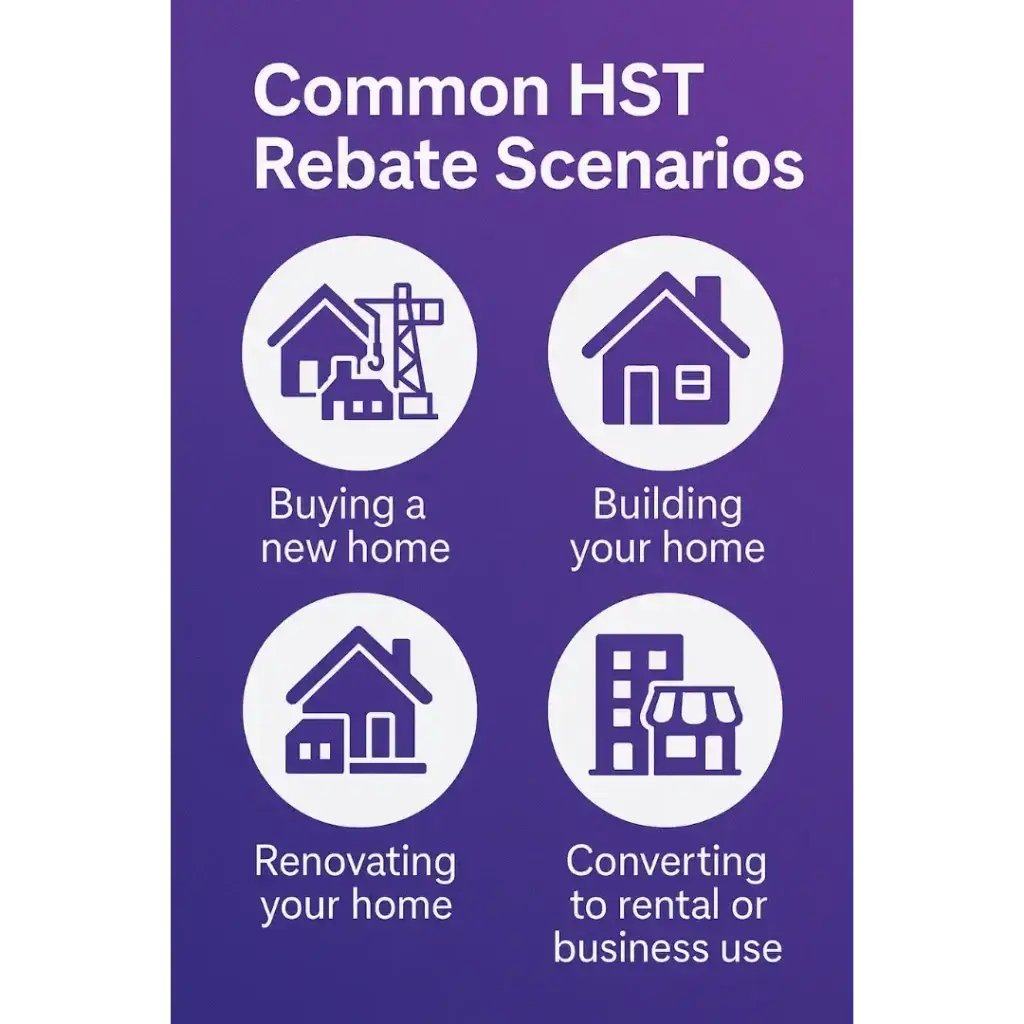
Eligibility varies slightly depending on the property type, but here are the main requirements:
- Ownership & Occupancy: You must legally own the home and live in it (or have a long-term tenant).
- New or Substantially Renovated: The property must be new or meet CRA’s “90% renovation” rule.
- Deadline: Apply within two years of closing or completion.
- Rental Properties: Must have a valid one-year lease in place.
- Builder Involvement: Confirm whether the builder already claimed part of your rebate.
✅ Pro Tip: Even if the builder handled your rebate, you might still be eligible for additional recovery. Always review your closing documents carefully.
Required CRA Forms for 2026
| Rebate Type | Form Needed | Applies To |
|---|---|---|
| New Housing Rebate | GST191 | Owner-occupied homes |
| Rental Property Rebate | GST524 + Schedule A | Long-term rental homes |
| Substantial Renovation | GST191 | Major home renovations |
| Modular/Mobile Home | GST191 | Primary residence units |
All forms can be downloaded from the CRA website under “Forms and Publications.”
📌 Important Notes
- You must apply for the rebate within 2 years of your closing date or substantial renovation completion.
- Forms involved:
- Form GST190 – New Housing Rebate
- Form GST524 – New Residential Rental Property Rebate
- Supporting documents may include: invoices, contracts, builder’s statements, proof of occupancy, or lease agreements.
🧠 Quick Example
You buy a new condo in Ontario for $400,000.
- Total HST paid: 13% of $400,000 = $52,000
- Federal rebate (5% portion): up to $6,300
- Ontario rebate (8% portion): up to $24,000
- Total potential rebate: up to $30,300, depending on criteria
Step-by-Step: How to Apply for the Ontario HST Rebate (2026 Guide)
Applying for the Ontario HST rebate might seem complex, but following the right process ensures you don’t miss out on thousands of dollars in potential savings. Here’s a complete breakdown of every step you need to take to file your rebate claim accurately and on time.
Step 1: Confirm Your Eligibility
Before starting the application, make sure you qualify for the HST rebate. The CRA is very strict about eligibility, and even a small detail can determine approval or rejection.
To be eligible, you must:
- Own the property — you’re listed on the purchase agreement and land title.
- Occupy the home as your primary residence, or have a long-term tenant with a signed lease if it’s a rental property.
- Apply within 2 years of your possession date or the substantial completion of your renovation.
- Ensure the home is newly built or substantially renovated (at least 90% of the interior replaced).
- Be the first owner or landlord to occupy or lease the property.
✅ Tip: If your builder already deducted the rebate amount from the purchase price, you may still need to confirm whether you’re required to apply directly to the CRA or if it was handled on your behalf.
Step 2: Gather All Required Documents
Collecting and organizing your paperwork early helps you avoid delays and CRA rejection letters. You’ll need the following based on your property type:
For New Home Purchases
- Agreement of Purchase and Sale (APS)
- Statement of Adjustments from your lawyer or builder at closing
- Proof of Occupancy: driver’s license, utility bills, property insurance, or other official mail showing your name and new address
- Builder’s HST Breakdown (if not included in your purchase price)
For Rental Properties
- All documents listed above, plus:
- A signed one-year lease agreement with a tenant
- Proof of rent payments (bank statements, deposit slips, or receipts)
For Substantial Renovations
- Invoices and receipts for all major work completed
- Building permits and contractor agreements
- Before-and-after photos to demonstrate 90% interior replacement
💡 Pro Tip: Create a digital folder with labeled PDFs. CRA processing becomes much faster if documents are clearly organized.
Note: Remember, your HST rebate claim may also intersect with your personal tax situation—especially if you’re applying as a homeowner. For a deeper understanding of what to include and how to file properly, explore our detailed personal income tax filing guide for Canadians.
Step 3: Complete the Correct CRA Form
Choose and fill out the right form depending on your situation:
| Property Type | Form | Description |
|---|---|---|
| Owner-Occupied New Home | GST191 | For homeowners who live in the property as their primary residence |
| Long-Term Rental Property | GST524 + Schedule A | For landlords leasing the property to tenants for at least one year |
| Substantial Renovation or Modular Home | GST191 | For homeowners who have rebuilt or significantly renovated their residence |
When completing the form, ensure every section is accurate and legible:
- Property and purchase details: address, builder name, possession date, and purchase price
- HST paid and rebate calculation (include both federal 5% and provincial 8% portions)
- Occupancy or lease details
- Signature and declaration confirming the accuracy of your submission
✅ Avoid common mistakes: wrong form selection, incomplete fields, or mismatched information between documents and your application.
Step 4: Submit Your Application
Once your form and documents are complete, you can file the application by mail or online.
Option 1 – By Mail
Mail your completed forms and supporting documents to:
Excise and GST/HST Rulings Centre
Summerside Tax Centre
275 Pope Road
Summerside PE C1N 6A2 Canada
🕵️ Tip: Use tracked mail or courier service to ensure your documents arrive safely and on time.
Option 2 – Online via CRA My Account
For homeowners only (not rental claims):
- Log in to your CRA My Account.
- Go to “Submit Documents” under the Correspondence section.
- Upload the completed forms and supporting PDFs or images (JPG, PDF, TIFF formats accepted).
CRA automatically records the submission date and confirms receipt digitally.
Step 5: CRA Review & Processing
Once submitted, CRA officers will review your application and documents.
⏱ Processing Time: Typically 4 to 8 weeks, though it may take longer during peak filing months.
During this stage, CRA may request:
- Clarification on ownership or occupancy
- Additional supporting evidence such as utility bills or lease copies
- Corrections if any section of the form is incomplete
If approved, your rebate will be:
- Mailed as a cheque, or
- Deposited directly into your bank account if you’re enrolled in CRA direct deposit.
✅ Important: Keep all original documents for at least 4 years. CRA can audit your application anytime within this period, and missing proof may result in repayment of the rebate.
Final Tip: If you’re uncertain about which form applies or how to calculate your rebate amount, consult a professional tax consultant like ANKTax Mississauga. We can review your documents, calculate your entitlement accurately, and ensure your 2026 HST rebate application is 100% CRA-compliant.
✅ Bonus Tips for a Smooth Application
- Apply early: Don’t wait until the deadline. Apply as soon as you have the required documents.
- Use a professional: Tax consultants or rebate specialists can help avoid costly mistakes.
- Keep digital copies: Store everything in a secure folder, the CRA may audit up to 4 years later.
- Be honest: Misrepresenting your use of the property (e.g., saying you live there when you don’t) can result in penalties and a forced rebate repayment.
Tips to Maximize Your HST Rebate in Ontario (2026)
Claiming your HST rebate can save you thousands, but only if your application is accurate and complete. Use these expert-approved tips to ensure you receive the maximum refund available under the CRA’s 2026 guidelines.
✅ 1. Confirm HST Inclusion
Check whether the builder included HST in your home’s purchase price or added it separately.
- If HST was included, your rebate might already be factored into your closing documents.
- If added on top, you’ll need to apply directly to the CRA for your refund.
✅ 2. Use a Tax Professional
Filing the rebate on your own can be confusing, especially when determining eligibility between GST191 and GST524 forms.
-
A professional tax consultant like ANKTax can handle the calculations, prepare the right forms, and prevent costly errors.
✅ 3. Keep All Receipts & Proof
Hold on to every invoice and proof of payment — especially for renovations or construction work.
-
CRA may audit your claim to confirm that at least 90% of the interior was replaced for substantial renovations.
✅ 4. Submit On Time
You have two years from the possession date (or substantial completion date for renovations) to apply.
-
Submitting early avoids delays and prevents last-minute issues with missing paperwork.
✅ 5. Plan Ahead (For Investors)
If you’re buying an investment property, make sure it meets the rental eligibility criteria.
-
You must have a minimum one-year lease signed and in effect before submitting the rebate.
Common Mistakes When Applying for the HST Rebate (and How to Avoid Them)
Even a small mistake can cause your rebate to be delayed or denied. Below are the top 10 errors applicants make — and how to steer clear of them.
1️⃣ Filing the Wrong Form
Mistake: Using GST191 when you should be using GST524, or vice versa.
Avoid It By: Confirming your property type. Use GST191 for owner-occupied homes or renovations, and GST524 (with Schedule A) for rental properties.
2️⃣ Missing the 2-Year Deadline
Mistake: Applying too long after your closing or completion date.
Avoid It By: Setting reminders to apply within 24 months of possession or completion.
3️⃣ Missing Proof of Occupancy or Tenancy
Mistake: Failing to show you or your tenant actually live in the property.
Avoid It By: Including at least two proof documents — such as a driver’s license, utility bill, or lease agreement.
4️⃣ Incomplete or Incorrect Information
Mistake: Typos, mismatched addresses, or wrong rebate amounts.
Avoid It By: Reviewing all fields carefully and using a calculator or spreadsheet to verify figures.
5️⃣ Missing Required Documents
Mistake: Omitting the purchase agreement, builder’s statement, or permits.
Avoid It By: Preparing a checklist and submitting all documents in full, even if some pages seem unimportant.
6️⃣ Assuming the Builder Filed for You
Mistake: Believing your builder claimed the rebate when they didn’t.
Avoid It By: Checking your Statement of Adjustments and confirming in writing whether the builder applied on your behalf.
7️⃣ Not Keeping Copies
Mistake: Sending original forms and losing track of them.
Avoid It By: Keeping digital and physical copies of every document for at least four years.
8️⃣ Claiming When You’re Not Eligible
Mistake: Filing as an owner-occupier when renting the unit, or vice versa.
Avoid It By: Being transparent about your use of the property. CRA penalties for misrepresentation can be significant.
9️⃣ Ignoring CRA Follow-Ups
Mistake: Failing to reply to CRA requests for clarification.
Avoid It By: Checking your CRA My Account and mail regularly and responding promptly with the requested documents.
🔟 Assuming All Renovations Qualify
Mistake: Believing any renovation qualifies for the rebate.
Avoid It By: Knowing that only substantial renovations (replacing at least 90 % of the interior) are eligible. Keep detailed before-and-after photos and invoices.
Navigating the HST Rebate Process? Let ANKTAX Help You Every Step of the Way

The HST rebate process in Ontario can feel like a maze—full of complex forms, strict deadlines, and detailed documentation. One small mistake can delay your refund or get your application denied altogether. Why take the risk?
ANKTAX makes the process simple and stress-free. At ANKTAX, we specialize in helping homeowners, real estate investors, and renovators across Ontario successfully claim their HST rebates. Whether you’re applying as an end-user or a landlord, our experienced tax professionals will:
- ✅ Review your eligibility and property use to ensure you meet CRA criteria.
- ✅ Organize and prepare all supporting documents, invoices, and proofs.
- ✅ Complete and file the correct CRA forms (GST191 or GST524) accurately.
- ✅ Handle CRA communication and follow-ups on your behalf.
- ✅ Maximize your rebate while keeping you 100 % compliant with current tax regulations.
✅ Why Choose ANKTAX?
We combine deep knowledge of CRA regulations with personalized client service. From first-time buyers to experienced developers, we’ve helped hundreds recover thousands in rebates—with zero hassle.


