
Introduction
Buying a new home in Ontario? You could be eligible for a significant New Housing HST Rebate in Ontario, potentially saving you thousands of dollars during the 2026 tax season! As of the upcoming 2026 filing year, this rebate is more relevant than ever. Alongside the existing New Housing Rebate, the federal government has introduced the First-Time Home Buyer (FTHB) GST/HST Rebate, giving qualifying first-time buyers an even greater opportunity to recover part or all of the federal portion of the HST.
According to the CRA, homebuyers may claim a rebate on the federal portion of the HST (5%) — and in many cases, on the provincial portion (8%) — if they meet specific eligibility criteria.
I’ve put together this 2026 step-by-step guide to walk you through everything you need to know about the New Housing HST Rebate in Ontario. Whether you’re a first-time homebuyer, custom home builder, or property investor, this guide will help you understand your eligibility, prepare your documents, and apply for your rebate confidently and correctly.
👉 For an in-depth overview of eligibility, forms, and common pitfalls, check out our complete guide on HST rebates in Ontario.
Let’s dive in!
Why This Matters Going Into 2026
Buying a home is expensive enough, but the 13% HST in Ontario can add a significant amount to your total cost. Fortunately, both the federal and provincial governments allow eligible buyers to recover part of that tax through rebates.
The rebate you qualify for depends on your situation:
- The New Housing HST Rebate (for most new or substantially renovated homes).
- The First-Time Home Buyer (FTHB) GST/HST Rebate, introduced in 2025 for new agreements signed after May 27, 2025.
If your closing, construction, or move-in happens in late 2025 or early 2026, this guide is for you.
Understanding the Rebates
1. The New Housing HST Rebate (Still Active in 2026)
The New Housing Rebate allows homebuyers to recover part of the HST (both the federal and Ontario portions) paid on a newly constructed or substantially renovated home.
You may qualify if:
- You purchased a new home or condo from a builder.
- You built or hired someone to build your home on land you own.
- You substantially renovated an existing home (typically 90% or more).
- The home is your or an immediate family member’s primary place of residence.
You cannot claim the rebate if the property is used primarily for investment, rental, or vacation purposes.
How Much You Can Get
- Federal portion: You can claim up to 36% of the 5% GST paid, for homes priced up to $350,000. The rebate is gradually phased out for homes priced between $350,000 and $450,000 and eliminated above $450,000.
- Ontario portion: You can claim up to 75% of the provincial portion (8%) of the HST, with a maximum rebate of $24,000. Unlike the federal rebate, this portion may still apply for higher-priced homes.
Example
If you buy a new home for $600,000 in Ontario:
- The federal rebate may be reduced or unavailable depending on the price.
- The Ontario portion could still give you up to $24,000 back.
That’s a significant savings when added to other tax benefits like first-time homebuyer incentives or RRSP withdrawals.
2. The New First-Time Home Buyer (FTHB) GST/HST Rebate
This program was introduced to help first-time homebuyers deal with high housing prices. It provides a much larger potential rebate — in some cases, a complete refund of the GST portion of the HST.
Key Highlights
- Full rebate for homes up to $1,000,000.
- Partial rebate for homes priced between $1,000,000 and $1,500,000.
- No rebate for homes priced at $1,500,000 or more.
- The program applies to agreements signed on or after May 27, 2025, and construction must begin before 2031 and be substantially completed by 2036.
Eligibility Requirements
To qualify, you must:
- Be at least 18 years old.
- Be a Canadian citizen or permanent resident.
- Not have owned or lived in a home you owned in the past four years.
- Intend to use the home as your primary residence.
- Be the first occupant of the home after purchase or construction.
If you’re buying with a partner, at least one of you must meet the first-time buyer criteria. You can only claim this rebate once in your lifetime.
Example
If you’re buying your first home for $950,000 in Ontario, you may receive a 100% rebate on the federal GST portion, saving around $45,000. You can also claim the Ontario portion rebate of up to $24,000, bringing your total tax savings close to $69,000 — a massive benefit for first-time buyers.
Note: Before You Apply — Don’t Forget About Personal Tax Filing
Applying for the new housing HST rebate in Ontario is just one piece of your financial puzzle as a homeowner. It’s equally important to ensure your personal taxes are filed correctly, especially if you’ve recently bought or built a home. For a detailed breakdown of what you need to know, check out our personal income tax filing in Canada guide. It walks you through everything from deductions to deadlines, so you stay compliant and maximize your refund.
Step-by-Step Guide to Apply for the New Housing HST Rebate
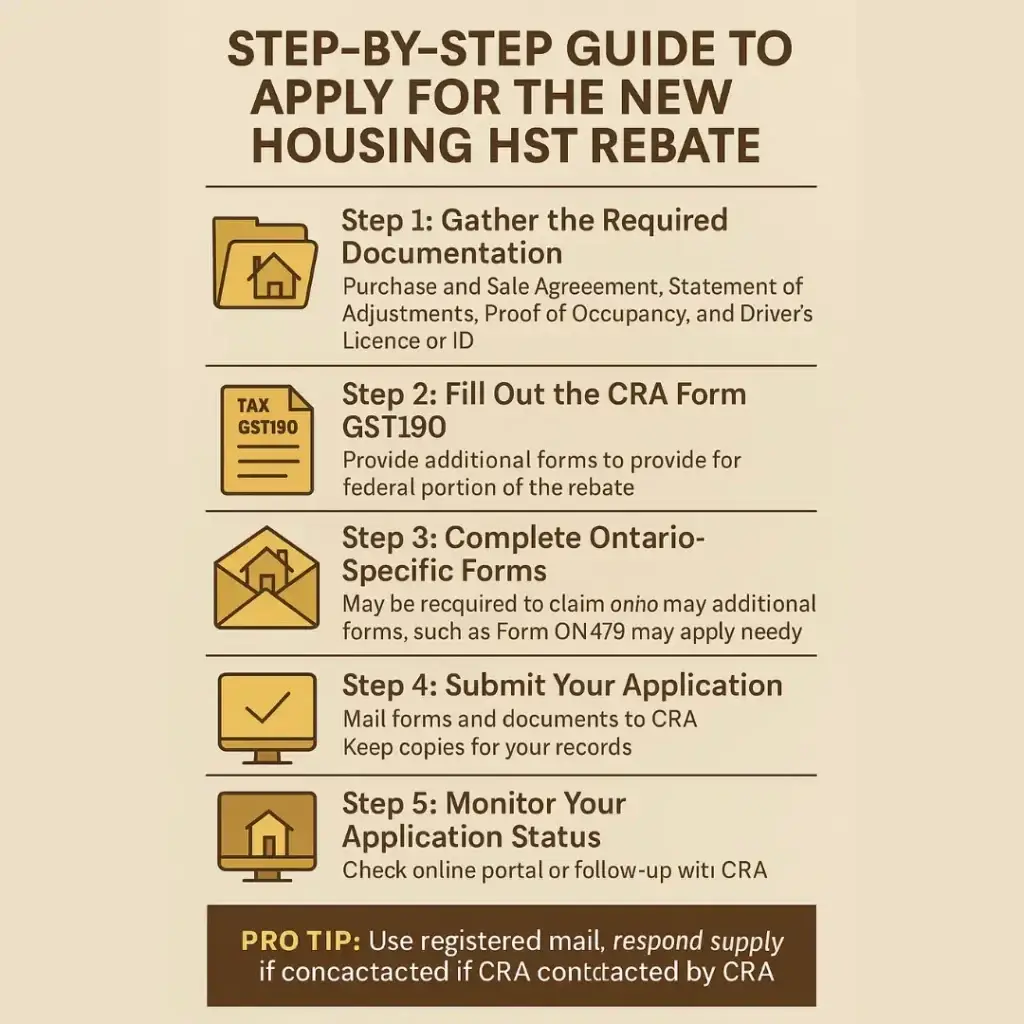
Applying for the New Housing HST Rebate in Ontario doesn’t have to be overwhelming, but it does require careful preparation and accurate documentation. To make things easier, here’s a detailed, 2026-ready guide to help you apply smoothly and avoid common mistakes.
Step 1: Gather the Required Documentation
Before you begin filling out forms, make sure you have all the necessary documents at your fingertips. The CRA (Canada Revenue Agency) will require proof of purchase, your intent to live in the home, and other supporting details. Here’s what you’ll need to gather:
- Agreement of Purchase and Sale – The contract between you and the builder or seller showing you purchased a newly built or substantially renovated home.
- Statement of Adjustments – Provided by your lawyer at closing, it outlines final financial details (e.g., purchase price, property tax adjustments, prepaid utilities).
- Proof of Occupancy – A recent utility bill, internet bill, or other service document showing your name and new home address. You must occupy the home within 12 months of possession or completion.
- Government-Issued ID – A driver’s licence or photo ID with your current home address, matching the property on your rebate claim.
- Invoices and Receipts (if applicable) – If you built or renovated the home yourself, include all relevant contractor invoices and material receipts.
💡 Pro Tip: Ensure all details (name, address, and dates) are consistent across documents. Small discrepancies — such as mismatched addresses or name spellings — can delay processing.
Step 2: Fill Out the CRA Form GST190 (Federal Portion)
The GST190 form is used to apply for the federal portion of the New Housing HST Rebate. It’s the main form for most new home purchases from a builder.
You’ll need to provide:
- Property Information: Address, possession date, and property type (e.g., new home, condo, or major renovation).
- Purchase Details: The total purchase price and HST paid.
- Rebate Calculation: The CRA determines the amount based on your home’s price and eligibility. You can estimate it using CRA’s online HST Rebate Calculator before filing.
You can download Form GST190 directly from the CRA website or complete and submit it online through your CRA My Account (digital submission is recommended for faster processing).
💡 Pro Tip: If your builder already credited you the rebate on your purchase price (a common practice for builder-supplied homes), confirm this before submitting a separate claim to avoid duplication.
Step 3: Complete Ontario-Specific Forms (Provincial Portion)
In addition to the federal form, Ontario has its own provincial rebate portion. To claim it, you’ll complete:
- Form RC7190-ON – Ontario Rebate Schedule, used to calculate the 75% provincial portion (up to a maximum of $24,000).
- Form GST191 – Used if you built your own home or substantially renovated one yourself (owner-built homes).
📌 Note: Some older references mention “Form ON479,” but that’s not used for the HST rebate — it’s an income tax form unrelated to this program. The correct form for Ontario’s housing rebate is RC7190-ON.
💡 Pro Tip: If your home’s price exceeds $450,000, you may not qualify for the federal rebate, but you can still claim the Ontario portion — it remains available even for higher-value properties.
Step 4: Submit Your Application
Once all forms are complete, it’s time to send your application.
You can:
- Submit online through your CRA My Account for faster processing, OR
- Mail the completed forms and supporting documents to the tax centre address listed on the GST190 form.
If mailing:
- Include all documents (purchase agreement, proof of occupancy, ID, receipts, etc.).
- Keep copies of everything for your records.
- Use registered or trackable mail so you can confirm delivery.
💡 Pro Tip: The CRA typically processes housing rebate claims in 6–8 weeks, but delays are common during tax season (March–June). Applying earlier in the year helps avoid longer wait times.
Step 5: Monitor Your Application Status
After submission, you can track the progress of your rebate:
- Online: Sign in to your CRA account to see real-time updates.
- By phone: Call the CRA’s GST/HST rebate line and have your application reference number and personal details ready.
If CRA requires additional documentation or clarification, they’ll contact you by mail or phone. Respond promptly to keep your file moving.
💡 Pro Tip: If you haven’t received an update after 8–10 weeks, contact CRA to confirm your application status. Keep your supporting documents easily accessible in case follow-up information is requested.
Bonus: Filing for the New First-Time Home Buyer (FTHB) GST/HST Rebate (2026 Onward)
If you signed a purchase agreement on or after May 27, 2025, and are a first-time homebuyer, you may also qualify for the new First-Time Home Buyer GST/HST Rebate.
This new program allows a 100% refund of the federal GST portion for homes up to $1,000,000, with a phased reduction up to $1.5 million.
While the CRA’s final application form is expected in early 2026, the documentation will be similar to the traditional rebate — so keeping your purchase and occupancy records organized now ensures an easier claim later.
Tips to Maximize Your Rebate
While applying for the new housing HST rebate in Ontario may seem straightforward, taking extra steps to ensure that your application is as thorough and accurate as possible can help you get the maximum rebate available. Here are some valuable tips to help you navigate the process and avoid any common pitfalls:
1. Double-Check All Forms for Accuracy Before Submitting
One of the most critical aspects of applying for the HST rebate is ensuring that all forms and supporting documents are filled out accurately. Small errors or omissions can lead to delays or rejections, and potentially even reduce the amount of the rebate you’re entitled to. Here’s how you can double-check:
- Verify all personal information: Ensure that your name, address, and other personal details are correct.
- Cross-check property details: Make sure the address of the new home or substantially renovated property is accurate, and ensure that all relevant dates (like closing or possession date) are correctly noted.
- Review calculations: If you’re completing rebate calculation sections, take an extra moment to confirm the figures. An incorrect calculation can significantly affect the rebate amount.
Pro Tip: Ask someone else to review your forms before submitting them, as fresh eyes may catch any mistakes you might have missed.
2. Make Sure You Meet the Filing Deadline
Filing for the HST rebate on time is essential, as missing the deadline can result in the rejection of your application. According to the CRA, rebate applications should be submitted within two years from the closing date of the property purchase or a substantially renovated home. Here’s what you can do to stay on track:
- Set a reminder: Mark your calendar with the filing deadline so you don’t miss it.
- Avoid procrastination: Submitting your application early can help reduce stress and give you extra time to address any issues that might arise.
Pro Tip: Don’t wait until the last minute! The sooner you file, the sooner you can receive your rebate.
3. Use Online Calculators to Estimate Your Rebate
To get a better idea of how much you can expect to receive, take advantage of the HST rebate calculators provided by the CRA or other online platforms. These tools can help you estimate the potential federal and provincial rebate amounts based on your home’s purchase price and other variables.
- Estimate before applying: Using these calculators before you begin your application will give you a better understanding of what to expect.
- Refine your numbers: Once you’ve input your home details, use the calculator to tweak the values and check for accuracy before completing the official rebate forms.
Pro Tip: While online calculators provide a good estimate, they may not always account for every specific detail of your situation. It’s a good idea to confirm the final calculation with a professional or through the official CRA form.
4. Consider Working with a Rebate Consultant or Tax Professional if Unsure
If you’re feeling uncertain or confused about the rebate process or the forms, consider seeking help from a professional. A rebate consultant or tax professional can offer guidance to ensure your application is filled out correctly and your rebate calculation is accurate. Here’s why you might want to consider this option:
- Expert advice: Professionals can provide clarity on complex rebate rules, especially if your property has unique circumstances (e.g., you’re building your own home or involved in a custom-built property).
- Time-saving: Working with an expert may speed up the process, reducing the chances of errors and eliminating the need to redo forms if issues arise.
- Maximize your rebate: A professional may also be able to help you find ways to qualify for higher rebates or ensure that you aren’t missing any potential savings.
Pro Tip: Make sure to choose a tax consultant with experience in HST rebates to ensure that they are familiar with the specific requirements for Ontario housing rebates.
5. If You’re Buying with a Partner, File Jointly and Include Both Names on Documents
If you’re purchasing the property with a partner (spouse, common-law partner, or family member), it’s essential to file jointly for the rebate. When both names are listed on the documents and application, the HST rebate amount may increase, as the CRA takes both applicants into consideration when determining the rebate eligibility.
- Joint ownership matters: Both names should be on the purchase and sale agreement, as well as all other forms submitted to the CRA.
- Clarify ownership details: Be clear about the ownership structure. If both parties will be living in the home, make sure this is reflected in the forms. For example, if you are both equally responsible for the purchase price, that can positively impact the rebate calculation.
Pro Tip: Be sure to include all relevant details in the application. If one partner has a greater share of the home, this should be indicated in the ownership documents.
By following these tips, you can maximize your chances of receiving the full HST rebate and ensure that your application process is as smooth as possible. A little bit of extra care and preparation will go a long way in ensuring you get the most out of this valuable financial benefit.
Pro Tip: If you are applying for the rebate for a newly built or substantially renovated home, remember that you have up to two years to apply from the closing date. So, don’t rush – make sure you gather all the necessary documents and review them thoroughly to ensure a successful claim!
Common Reasons CRA Denies Rebate Claims

Avoid these pitfalls to improve your chances of success:
- Home not used as a primary residence.
- Application filed after the two-year deadline.
- Purchase agreement date before the FTHB eligibility period.
- Property rented out or resold before occupancy.
- Incomplete or inconsistent paperwork.
Attention to detail is the difference between approval and denial — and that’s where professional help pays off.
Example Scenarios
Example 1: First-Time Buyer in Mississauga
Saira buys her first condo for $900,000 in late 2025.
- She qualifies for a full FTHB rebate of around $45,000.
- She also qualifies for the Ontario rebate of $24,000.
She’ll file for both when she submits her 2026 tax return.
Example 2: Returning Buyer in Brampton
Jason buys a new home for $650,000 but isn’t a first-time buyer.
- He qualifies for the Ontario HST rebate of $24,000.
- The federal rebate is partially phased out.
He’ll still save about $25,000–$30,000 total.
Example 3: Rental Investor
A buyer purchasing a $700,000 property to rent out isn’t eligible for the personal-use rebate, but can apply under the New Residential Rental Property (NRRP) Rebate, which has different requirements.
Key Deadlines for the 2026 Filing Season
- Apply within two years of closing or completion.
- Occupy the home within 12 months of purchase or completion.
- For the new FTHB rebate, agreements must be signed on or after May 27, 2025, with construction started before 2031.
If you’re buying in 2025, you’ll likely claim your rebate when you file taxes in spring 2026.
Resources and Support for Ontario Homebuyers
Don’t go it alone — plenty of resources can help you:
- CRA New Housing Rebate Guide
- Ontario Ministry of Finance: HST Rebate Info
- Form GST190 (CRA)
- Consult with a tax specialist or real estate lawyer for personalized guidance.


